George Grossmith (1847-1912)
George Grossmith was an actor and theatrical manager. But he is best known for his co-authored novel The Diary of a Nobody, in which the suburban clerk Pooter takes his family on holiday to Broadstairs.

George Grossmith was an actor and theatrical manager. But he is best known for his co-authored novel The Diary of a Nobody, in which the suburban clerk Pooter takes his family on holiday to Broadstairs.

Maidstone convict prison, opened in 1909 beside the town’s older jail, became a distinctive English penal site for first-offence star class prisoners serving long sentences. Its concentration of white-collar offenders, reprieved lifers, and sex offenders, alongside a comparatively relaxed regime and privileged work like printing, exposes how class and reputation shaped punishment from the interwar years through wartime evacuation and later rehabilitation experiments.

Elizabeth Carter’s long residence in Deal shaped a public image of austere discipline that enabled an extraordinary career as a poet and as the translator of Epictetus. Anecdotes of dawn alarms, Church loyalty, and skepticism toward Wollstonecraft sit alongside her advocacy of women’s education and later reassessments by figures such as Virginia Woolf, revealing how gendered expectations framed her reputation.

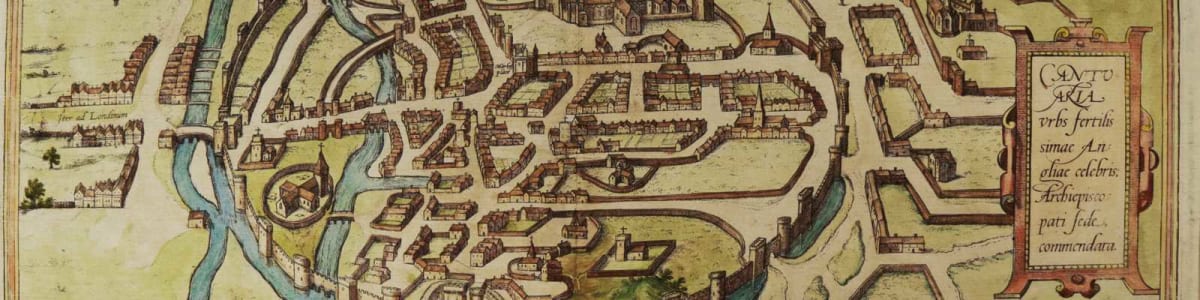
John Boys’s late eighteenth-century survey of Kent agriculture links soils, farm tenures, implements, and crop rotations to a county-scale programme of “improvement.” Places such as Betteshanger, Romney Marsh, Thanet, and the Stour drainage works show how drainage, roads, hops, orchards, and livestock were managed through local knowledge, experiment, and policy debates over tithes, commons, and enclosure.

Admiral Sir Cloudesley Shovell links Kent’s naval and political world to the 1707 Scilly Isles disaster that drove Parliament to seek a solution to longitude at sea. His connections to Knowlton Court, Deal’s Downes anchorage, and Rochester civic life show how landownership, naval service, and Whig politics intersected in late Stuart Britain.

Sheppey was in a vulnerable position at the entrance to both the Medway and Thames Rivers. It had no army and limited military support from the Crown, making it an obvious target during the Anglo Dutch War.

Street conflict in Canterbury on Christmas Day 1647 exposed sharp tensions between Puritan governance and popular festive custom. Shopkeepers and townspeople resisted Lord Mayor William Bridge’s enforcement of compulsory trading, and the riot’s aftermath fed wider Kentish protest that helped set conditions for the Battle of Maidstone.

The residents of Sheppey were trained to defend the island and the entrance to the Thames, against Spanish invasion. But historic records show tension between the Crown’s military agenda and the everyday hardship of the local islanders.

Leonard and Thomas Digges shaped Tudor Kent through practical mathematics, cartography, astronomy, and coastal engineering that linked estates around Canterbury to Dover Harbour and national defense planning. Family fortunes swung with the Wyatt rebellion and later political disputes, revealing how scientific work, landholding, and state service intertwined in the sixteenth century.

St Augustine’s Missionary College in Canterbury trained nearly a thousand Anglican clergy for overseas missions, creating a cosmopolitan student body that included African and Black British Augustinians. Marguerite Poland’s novel A Sin of Omission and archival traces of figures like Stephen Mnyakama reveal how education, sport, and discipline shaped missionary identity while colonial attitudes limited support after graduation. The college’s wartime destruction and later reuse show how imperial and religious histories remain embedded in the city’s built landscape.

Kentish place-names in Russell Hoban’s Riddley Walker reveal how language, landscape, and community memory mutate after catastrophe. Invented toponyms and a hand-drawn map recast real sites such as the Stour, Canterbury, Thanet, and Dungeness, showing cartography as a tool that grants authority and forces readers to recover meaning from familiar sounds.

Kentish place-names shape literary landscape by carrying layered histories of settlement, language, and land use that writers adapt to evoke authenticity and deep geography. Ordnance Survey maps and close reading trace how authors and filmmakers deploy real, altered, and invented toponyms across Kent, from the Stour valley to Romney Marsh, to conjure journeys, belonging, and regional character.